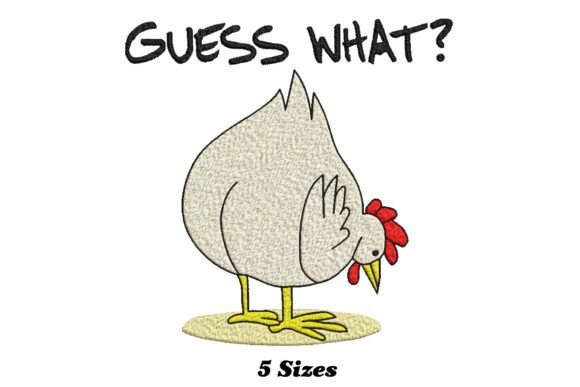
Review: Guess What Funny Chicken Butt Design
As a designer who spends half my life staring at stitch maps and the other half debugging thread breaks, I have learned that not every cute concept translates into a clean embroidery project. When I first pulled up the Guess What Funny Chicken Butt file, I was skeptical. Humor in embroidery is tricky; it often relies on timing or context that doesn’t always survive the translation from screen to fabric. However, after running this design through several test hoops and evaluating its potential for my current client roster, I found it to be a surprisingly versatile asset for anyone in the Animal Quotes niche.
First Impressions and Visual Personality
The immediate mood of this design is whimsical and lighthearted. It does not try to be realistic, which is a smart move for machine embroidery. Realistic feathers require complex satin stitch work and high stitch density, which can lead to puckering on lighter fabrics. Instead, this design leans into a cartoonish charm that feels approachable and fun. The layout is compact, making it ideal for items where space is at a premium. For an Etsy seller or a small shop product creator, this visual personality screams "impulse buy." It is the kind of graphic that makes a customer smile while scrolling, which is half the battle in digital sales.
What stands out most is the balance between detail and simplicity. The lines are clean, suggesting that the digitizer prioritized stitch clarity over unnecessary complexity. This is crucial for maintaining professionalism in a finished product. A messy design looks amateurish, but this one holds its shape well, even when viewed from a distance.
Real-World Application: The Tote Bag Test
To truly evaluate a design, you have to imagine it on a real item. I recently had a request for a batch of reusable grocery bags for a local farmer’s market vendor. They wanted something quirky to break the ice with customers. I chose Guess What Funny Chicken Butt for this tote bag design application. Why? Because tote bags are usually made of canvas or heavy cotton, which provides a stable base for embroidery.
The result was excellent. The design sat prominently on the front panel without overwhelming the bag’s utility. The humor acted as a conversation starter, exactly what the client wanted. This scenario highlights why this design works so well for custom apparel and accessories. It is not just a picture; it is a social cue. Whether you are stitching it onto a sweatshirt embroidery project for a college student or adding it to a kitchen towel, the context amplifies the joke.
Versatility Across Product Lines
Beyond tote bags, this design has significant potential across various categories. For baby embroidery, it adds a touch of gentle humor to onesies or burp cloths, provided the parents have a sense of humor. For holiday embroidery, it could be part of a larger Easter collection, paired with pastel thread colors to soften the edge. I also see it working beautifully as an embroidered patch. Patches are trending, and a small, funny motif like this allows crafters to experiment with placement on denim jackets or backpacks without committing to a large, permanent stitch-out.
If you are a craft business owner looking to expand your design assets, this file fits neatly into the Embroidery category for home decor. Imagine it on a pillow cover in a playful living room or on an apron for a chef with a silly side. The key is matching the thread colors to the product’s vibe. Bright, contrasting threads make it pop on dark fabrics, while monochromatic schemes can make it subtle and sophisticated on light materials.
Technical Considerations and Fabric Choices
While the design is robust, it is not immune to the physics of embroidery. You must be mindful of your hoop size and fabric choice. On stretchy fabrics like jersey knits, using the wrong stabilizer can cause the design to distort. I recommend a cut-away stabilizer for garments that will be washed frequently, such as t-shirts and sweatshirts. For woven items like towels or pillows, a tear-away stabilizer usually suffices, but always test on scrap fabric first.
Be cautious with very thin or delicate fabrics. The fill stitch areas in the chicken’s body may pull slightly if the fabric lacks structure. In such cases, consider using a backing fabric or switching to an applique design technique if the file supports it, though this specific file appears to be a standard stitch-out. Also, watch out for dense stitch areas on curved surfaces like caps. The curvature can cause thread bunching if the density is too high for the material.
Another critical factor is thread colors. Since this is a humorous design, color contrast is vital. If you stitch white thread on a white shirt, the joke gets lost. Always check your design in black and white mockups to ensure the shapes remain distinct regardless of color choices. This is a pro tip for any digital embroidery file user: if it doesn’t read well in grayscale, it won’t read well in color.
Commercial Viability and Brand Consistency
For commercial embroidery professionals, consistency is key. This design helps build a brand identity that is fun and approachable. It signals to buyers that you do not take yourself too seriously, which can increase trust and engagement. However, always verify the licensing terms before selling finished product items. Most designers allow commercial use for physical goods, but restrictions may apply to digital resale. Check the specific license included with your purchase.
When creating printable mockup images for your online store, ensure the lighting highlights the texture of the stitches. Buyers want to see the quality of the work. A well-lit photo of this design on a textured fabric can significantly boost conversion rates for your personalized gift listings.
Final Verdict for Makers and Designers
The Guess What Funny Chicken Butt design is a solid addition to any embroidery library. It is not just a novelty; it is a well-digitized piece that performs reliably across various applications. From small shop product lines to one-off custom apparel orders, it delivers both aesthetic appeal and practical durability. Just remember to respect the technical limits of your machine and fabric. Test, adjust, and stitch with confidence. This design proves that humor and quality can coexist in the hoop, making it a valuable tool for any creative entrepreneur looking to add a splash of whimsy to their portfolio.